
Long-term well-being doesn't come from restrictions. It starts with how we nourish our bodies every day.
Eating right can seem complicated.
Protein intake. Dietary supplements. Blood sugar. Fasting. Superfoods. Digestion. Metabolism. Anti-inflammatory diet.
It always seems like there's something else I should know or keep an eye on.
But before we start optimizing everything, it’s worth going back to the basics.
A good diet doesn't have to be perfect, strict, or complicated. The World Health Organization highlights four key principles of healthy eating: adequacy, balance, moderation, and variety.
Simply put, this means giving our bodies enough of what they need, eating a varied diet, and developing habits that we can actually stick with for the long term.
From the perspective of long-term well-being, the goal isn’t simply to eat less. What’s important is to nourish your body in a way that supports your energy, strength, skin and brain health, and overall well-being—even years down the road.
This is a good place to start.
1. Build your meals around real food
You don't need a complicated diet plan.
Start by making sure that most of your meals are based on foods that are as minimally processed as possible and rich in nutrients.
For example:
- vegetables;
- fruits;
- high-quality protein;
- legumes;
- whole-grain products;
- nuts and seeds;
- healthy fats.
The WHO recommends eating a varied diet and choosing whole-grain products, vegetables, fruits, and legumes as sources of carbohydrates. Adults are advised to eat at least 400 grams of fruits and vegetables per day.
That doesn't mean every meal has to be perfect.
Instead, ask yourself: What could I add to this meal to make it more nutritious?
Maybe a handful of green vegetables. Some berries. A source of protein. A few seeds. Served with a salad or vegetables on the side.
Long-term well-being doesn't depend on a single, extraordinary superfood. What matters more is the sum of your daily choices.
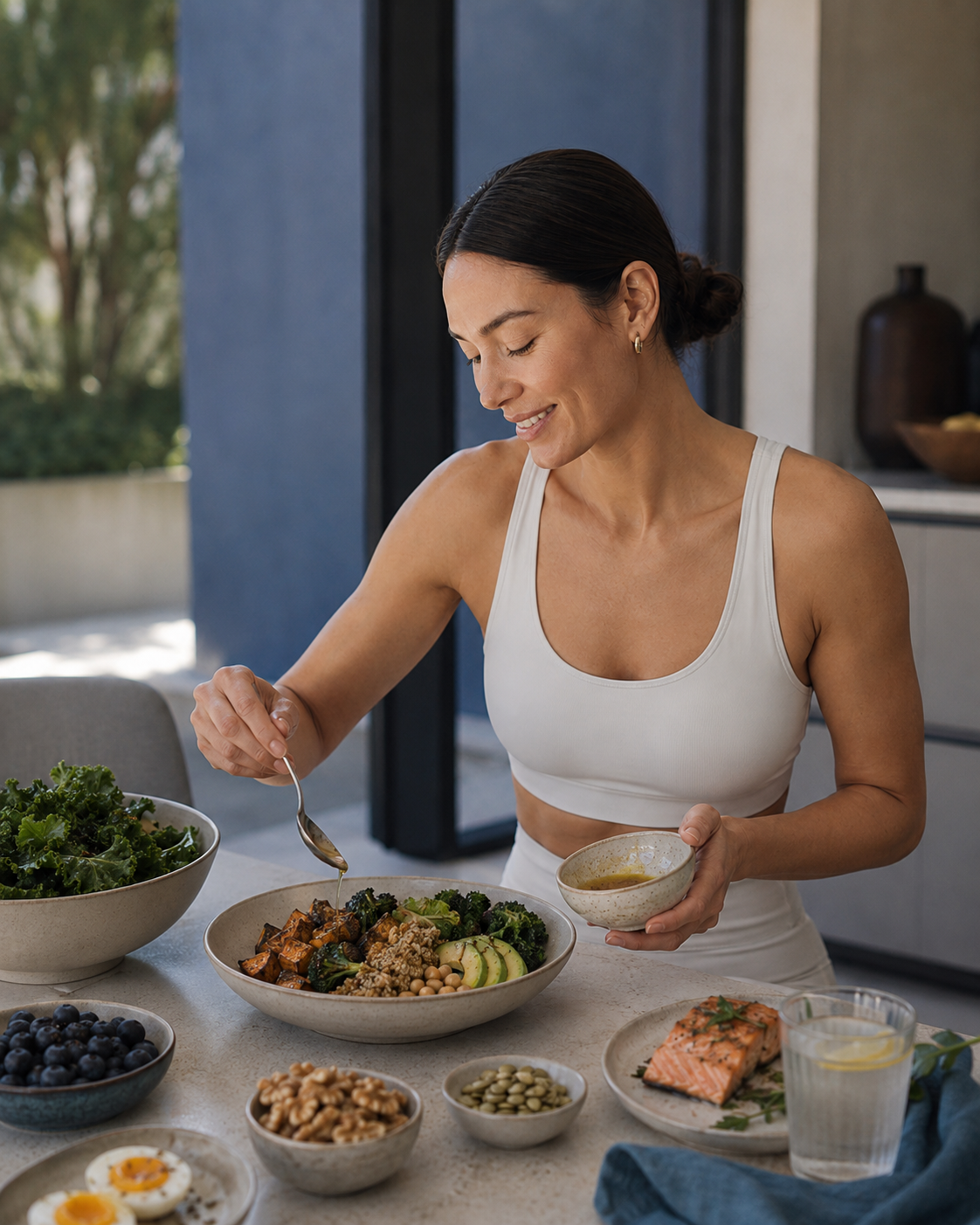
2. Make a conscious effort to prioritize protein
As the years go by, maintaining muscle mass becomes increasingly important.
Muscles don't just affect your appearance. They support your strength, mobility, metabolism, independence, and your ability to continue doing everything you love in the future.
Protein provides the body with the amino acids it needs to build and maintain tissues, including muscles.
Instead of getting hung up on exact numbers, start with a simple principle: include a good source of protein with every main meal.
For example, this could be:
- egg;
- fish;
- chicken;
- Greek yogurt or cottage cheese;
- tofu or tempeh;
- beans and lentils;
- high-quality meat;
- A protein-rich smoothie, if needed.
Protein requirements depend on age, body weight, activity level, and health status; therefore, there is no single amount that is right for everyone.
Glowly's simple principle: don't leave protein to chance in your diet.
3. Eat a more varied diet
Long-term well-being doesn't mean you have to eat only plant-based foods.
However, it is a good idea to include more vegetables, fruits, legumes, whole-grain products, nuts, and seeds in your diet.
They provide the body with fiber, vitamins, minerals, and a wealth of natural plant compounds.
The WHO recommends that adults consume at least 25 grams of dietary fiber from natural food sources each day.
Don't just focus on quantity. Think about variety, too.
Try adding the following to your menu this week, for example:
- dark green leafy vegetables;
- berries;
- tomatoes;
- carrots;
- broccoli and cauliflower;
- herbs;
- ube;
- lentils;
- nuts;
- seeds.
You don't have to eat everything every day. What's important is to include a variety of colors, flavors, and nutrients over the course of the week.
More color. More variety. More nutrients.
4. Choose carbohydrates based on quality, not fear
Carbohydrates are one of the most confusing topics in modern nutrition.
But not all carbohydrates are the same.
Oatmeal and a sweet pastry do not have the same effect on the body. The same is true of lentils and a sweetened soft drink.
The WHO recommends getting carbohydrates primarily from whole-grain products, vegetables, fruits, and legumes. The Harvard Healthy Eating Plate also emphasizes that, when it comes to carbohydrates, quality is what matters most.
Some good everyday choices might include:
- oat flakes;
- quinoa;
- barley;
- brown rice;
- whole-grain bread;
- beans and lentils;
- fruits;
- root vegetables.
There's no need to be afraid of carbohydrates. Instead, choose those that provide not only energy but also fiber and other valuable nutrients.
5. Don't be afraid of healthy fats
Fat is an important part of a healthy diet.
What matters, however, is the type of fat you choose.
Good sources of unsaturated fats include, for example:
- extra virgin olive oil;
- nuts;
- seeds;
- avocado;
- fatter fish.
The WHO recommends choosing unsaturated fats over saturated and trans fats.
Healthy fats help make meals more satisfying and enjoyable.
A salad doesn't have to be dry. You can add olive oil to the vegetables. Add nuts and seeds to the yogurt.
Food should nourish you, but it should also actually taste good.
If eating constantly feels like restriction and deprivation, it's hard to make it a way of life.
6. Focus on the plate, not on perfection
If you don't know how to plan a meal, keep it simple.
A good visual starting point is:
- about half the plate: vegetables and fruits;
- about a quarter: high-quality protein;
- about a quarter: whole-grain products or other fiber-rich carbohydrates;
- In addition: a good source of healthy fats.
It is similar to Harvard's Healthy Eating Plate model, which emphasizes vegetables, fruits, whole grains, high-quality protein, and healthy fats.
This isn't a strict rule. A soup, stew, or bowl of food doesn't always divide exactly into four portions. And it doesn't have to.
The idea is simply to have a simple framework that you can fall back on.
7. Drink enough water
When you're focused on food, it's easy to forget to drink.
Water supports the body's normal functioning, and an individual's fluid needs depend, among other things, on activity level, diet, and health status.
You don't need to force yourself to drink from a huge bottle all day long. Just make water a natural part of your day.
- Keep water within reach.
- Drink it with your meals.
- Drink regularly throughout the day.
- Make sure that most of your fluid intake comes from water, not sugary drinks.

8. Leave some room for enjoyment, too
A diet that supports long-term well-being should also leave room for birthday dinners. For dessert. For the holiday table. For a glass of wine with friends, if you’d like. For your favorite pasta.
Food is not just about nutrients.
It's also about culture, people, memories, and enjoyment.
A single meal doesn't determine your health. Just as a single salad doesn't guarantee a long life, a single dessert doesn't ruin a healthy lifestyle.
Try to look at the bigger picture. What you do most of the time matters much more than what you do occasionally.
9. Dietary supplements come after the basics
Dietary supplements may have their place.
They can help make up for certain deficiencies, address a specific need, or supplement one's diet.
But they are no substitute for good food.
Before adding another dietary supplement, ask yourself:
- What does my daily diet actually look like?
- Am I getting enough protein?
- Do I eat vegetables most days?
- Am I getting enough fiber?
- Does the menu regularly include healthy fats?
- Is my diet varied?
- Should I take this dietary supplement because I have a reason to—or just because someone online recommended it?
Both food and dietary supplements have their own role to play.
It is important to know what role each of them plays.
10. Start with what you can actually keep
You don't have to completely change your diet tomorrow.
Choose one or two habits and start there.
For example:
- Add protein to your breakfast;
- Eat more vegetables with your lunch;
- Choose a piece of fruit for the afternoon;
- Use olive oil when cooking;
- Add beans or lentils to some of your meals;
- Drink more water throughout the day;
- Plan a few dinners in advance.
Once these become second nature, move on to the next step.
Long-term well-being is a long-term game.
Your diet needs to be able to keep up with you.
Glowly: A Simple Diet Reset
If you want to start somewhere, try this at your next meal:
- Choose a high-quality source of protein.
- Add at least one vegetable or fruit.
- Add a suitable fiber-rich carbohydrate.
- Add a good source of healthy fat.
- Sit down and enjoy your meal.
That's enough.
You don't have to optimize everything today.
The Glowly Approach
At Glowlys, we believe that your diet should support your life—not take over it.
The goal isn't to eat perfectly.
The goal is to develop a diet that helps you feel energetic, strong, and well-nourished now, and that will continue to support your body for years to come.
Long-term well-being doesn't mean eating less or scaling back your life.
This means that you're giving your body more of what it needs to function well.
Nourish your body well. Live well. Shine from within.
This article is intended for general educational purposes only and is not a substitute for personalized medical or nutritional advice. Individual needs may vary, particularly in cases of pregnancy, health issues, eating disorders, allergies, or medication use. If necessary, consult a doctor or a qualified nutritionist.